

Blog Archives
How Your Comfort Zone is Limiting Your Language Development
Posted on February 25, 2015
By Emily Stallard, Owner at Orchid English
Recently I was speaking with a business contact and friend who is Japanese and who speaks excellent, see-if-you-can-spot-he’s-not-a-native-speaker English. What, in his opinion, did very high level non-native English speakers have in common? His advice: you need theory and also, crucially, practice. The practice part is where we need to leave our language comfort zone.
Language Comfort Zone 1: Books and silent self-study
This is my experience learning Japanese and I’m sharing it so that you don’t copy it! When I lived in Japan I used to study Japanese a lot. My teacher gave me homework and I would spend a long time studying; during my commute, at lunch and at weekends. Disappointed at how long it was taking me to be able to have a conversation, I would easily forget vocabulary and kanji that I had learned a few months before. It would take me a while to access the words I wanted too.
My Japanese friends spoke with me in Japanese at the weekends and I spoke to my colleagues in Japanese between classes. However, as a result of teaching English all day, I didn’t spend a large proportion of my time speaking Japanese. I didn’t put myself in a Japanese immersion environment where I had to communicate in new and challenging ways. I was in my language comfort zone most of the time; speaking English, or Japanese with people who I knew for short periods.
Language Comfort Zone 2: Listen and Repeat
Students who use a listen and repeat method to study slow their learning in a similar way. Listen and repeat is stress-free because you won’t be caught out by a question you don’t know the answer to. To progress, we need to produce sentences of our own spontaneously, when someone else is partly in control of the conversation. Listen and repeat often only familiarises students with one accent of English, and this is a nice clear accent done for the recording.
Advice on Leaving Your Language Comfort Zone
If you can speak to people and feel the stress of not knowing words, guessing and not knowing what’s coming next in the conversation, this is really the high-progress zone. Living in Japan, it was stressful to be in situations where I didn’t understand what was being said to me in Japanese, or I couldn’t express myself. But looking back, I wish I had had put myself in more situations like that. At parties and other social events where the conversations were in Japanese or French I remember feeling awkward. But actually it was good practice and people were almost always nice about my linguistic efforts. The parties were still fun!
So for real progression you must leave your language comfort zone and get stuck in. Lots of students do not take opportunities to practise outside of the classroom. They speak their own language with their friends and colleagues so the new words and structures they have learned in English are soon are forgotten. Knowing enough English to go to shops in London is quite easy to achieve and this becomes their new language comfort zone.
If you are worried about making mistakes ask yourself this: when non-native speakers of your own language speak to you and make mistakes, do you think they are stupid? Of course not; you know your language is complex and hard for people to master perfectly.
Read about why you should never say “I don’t speak English” here.
English for the Service Industry
Posted on May 28, 2014
Lots of people come to London to work in the service industry and it’s important to speak correctly, especially if you are repeating the same phrases over and over again.
Here are some top tips based on English mistakes we hear a lot in cafés, restaurants, hotels and bars:
“Do you want coffee?” is fine casually between friends but “Do you want coffee?” with a customer or client sounds abrupt. “Would you like coffee?” is much better in this situation. Similarly you can say; “Would you like milk?” or “Would you like me to take a message?”
Often this mistake is a result of “do you want” being appropriate in the speaker’s native language. In French it is polite for a waiter or waitress to say “Que voudriez-vous?” (“What do you want?”) because the type of “you” chosen is a formal one.
Think about whether what you’re doing for the customer has been planned in advance or not, and this will help you choose the best grammatical structure. “I will” or “I’ll” is for a spontaneous decision. If the customer says; “Hello, can I have a mojito please?” you should say; “Yes certainly, I’ll bring it over to your table”.
We often hear; “I’m going to bring it over to your table” in response to a request, but this is incorrect because “going to” is for a pre-arranged plan. If the customer asks; “Can you substitute chips for salad please?” you could reply; “Yes, I’ll tell the chef.”
Similarly, saying “I bring it over” (present simple) just tells the customer that on a regular basis you bring coffee to customers.
The “P” in receipt is silent. Yes, seriously. The “P” in the spelling is a relic from the Latin origin word so it has been a long time since we pronounced it! We have also heard the “T” in “Merlot” pronounced when this should also be silent.
If you are describing a woman politely you can use the word “lady”; “She is a tall lady”. Strangely enough, addressing a female customer as “Lady” as in, “Here you are, lady” is actually very derogatory and casual. You should use “Madam” in this situation; “Here you are, madam”.
Thanks very much for reading, and have a nice day now!
Do you have any more tips to add? Please let us know on the Orchid English Facebook page or on the Orchid English Twitter feed.
False Friends in English
Posted on June 17, 2012
Today I’d like to explore the hilarity of false friends in English. What’s a false friend in English? It’s a word that sounds like it would be the same in two languages, but it has a different meaning.
French
When I lived in Paris a colleague called me on my mobile, beginning in a polite tone of voice; “j’espère que je ne te dérange pas” I understood the first part; “I hope that I’m not” and, somewhat confused, reassured her that she wasn’t. I spent the rest of the conversation thinking that surely she couldn’t be wondering whether she was making me “deranged”! On looking up the word later it made sense, “déranger” in French means “disturb” in English.
I also had several strange conversations with French students of English, telling me they had just “passed” an exam. “Congratulations!” I’d reply. “Oh no, I haven’t got the result yet”, they’d reply. Confusingly, “passer un examen” means “take an exam” rather than “pass” it.
In France it’s perfectly acceptable to “demande” something, it just means to “ask” and doesn’t necessarily have such a forceful nuance as English “demand”.
When English words are imported into other languages, they may take on a meaning subtly or spectacularly different from the original meaning. A French woman once told me that she had gone to the hairdresser for a “brushing”. I wondered why on Earth she couldn’t just brush her hair herself, and then noticed that lots of hairdressers in France advertise “brushing” in the window. It means “styling”, something her hairdresser probably was better at.
Japanese
In Japan, at the end of the season, you might go to a “baagen” (sale) hoping to pick up something that in English is a “bargain”. But don’t be tempted to buy that ill-fitting neon tracksuit just because it’s cheap! If you avoid this common pitfall, people will describe you as “sensu ga aru”. This doesn’t mean that you have good “sense” but rather that you have good taste. In English if you said that someone has “good sense” it would sound more like they always locked up their house properly, ate sensibly and so on.
While I was researching this I was delighted to find that the Japanese have invented the word “dokutāsutoppu”, meaning when a doctor tells a patient to stop doing something. I don’t believe that there is a specific word for this in English. We should start using it though;
“I really love red meat but when I went to the clinic this week I got a doctorstop on it.”
“Oh bad luck”
German
Intriguingly, in German “Oldtimer” means an old car, rather than a flippant way to describe an elderly person. While I do love this, I’m not sure we could absorb this seamlessly into English:
“I can’t get my car out, some oldtimer’s in the way.”
“Great trade-in prices on oldtimers!”
There are also some interesting false friends among different varieties of English.
Australia
My cousin’s daughter announced that she wanted her “stroller”. Intrigued, I responded “That’s OK, go and get it” because I didn’t know what she was talking about. When the little girl came back pushing it, I understood. I mentioned to my cousin that in the UK we call that a “buggy” and she laughed and said it sounded like something horrible you find in your nose.
United States
“A moot point” in the US means something unworthy of discussion, whereas in the UK it’s the opposite, something controversial or undecided. In punctuation, “hash” to me means “#” and “pound” means “£”. I discovered through using American automated phone systems that in American English “pound” means “#”.
British speakers increasingly use American English words due to the influence of the media, which can create ambiguities. Does “you look smart” mean that you are dressed formally, or that you look clever?
So if English isn’t your first language take heart, there is no one “correct” version, and even native speakers get confused by other native speakers.
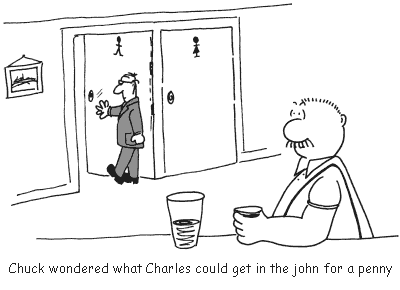
Do you know any more false friends in English?
About Orchid English
High quality English language classes for professionals. We come to your company in London at your convenience.
Follow Us Online...